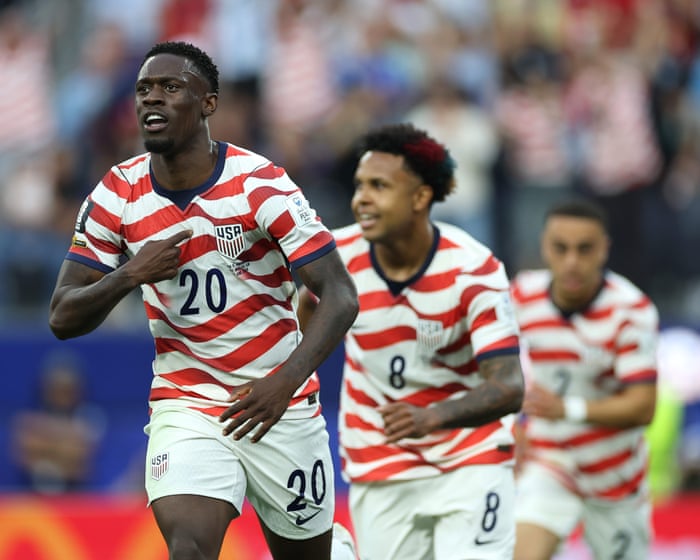
The 2026 World Cup, set to be hosted by the United States alongside Canada and Mexico, is already illustrating a broader narrative about the nation. Contrary to former President Donald Trump's vision of a homogenous America, the tournament and the U.S. team itself are emblematic of the country’s rich diversity and the impact of migration.
Recently, the Department of Homeland Security (DHS) caught the attention of social media users with a post that sparked conversations about national identity and patriotism. Following the U.S. national team’s impressive 4-1 victory over Paraguay, DHS shared an image featuring American players Chris Richards, Sergiño Dest, and Folarin Balogun celebrating their win. The image was boldly captioned with "DEFEND THE HOMELAND" and the phrase "OUR SOIL," suggesting a deeper message about defending American values and culture.
The Symbolism of Diversity
The composition of the U.S. national team itself is a testament to the diverse tapestry that is modern America. Players like Sergiño Dest, who was born in the Netherlands to a Surinamese-American father and Dutch mother, and Folarin Balogun, born in New York to Nigerian parents and raised in England, highlight the multicultural backgrounds that enrich the team. Chris Richards, hailing from Alabama, further adds to this diversity, representing the blend of local and international influences shaping American soccer.
A Global Stage Reflecting Local Values
The upcoming World Cup serves not only as a global sporting event but also as a stage to reflect and celebrate the multicultural essence of the host nations. The U.S., often described as a melting pot, finds in this tournament an opportunity to showcase how its diverse populace contributes to its successes, both on and off the field.
While Trump's rhetoric often centered around a singular vision of American identity, the World Cup underscores the reality that the country's strength lies in its variety. It is this mix of cultures, experiences, and backgrounds that fuels innovation and excellence, as exemplified by the national team's performance.
Challenges and Opportunities
Hosting the World Cup in 2026 presents both challenges and opportunities for the U.S. On one hand, it is a chance to boost infrastructure, tourism, and the global perception of the country. On the other, it poses logistical challenges and the need for cohesive coordination between the host countries.
However, the overarching narrative remains positive. The event allows the U.S. to project an image of unity and inclusivity, countering the notion of a monolithic national identity. It celebrates the contributions of immigrants and their descendants, underscoring the idea that America is continually shaped by those who come to its shores.
"The World Cup is more than just a tournament; it's a celebration of what makes us human: our ability to come together, compete, and appreciate our differences," said a sports analyst speaking about the significance of the event.
Looking Forward
As the 2026 World Cup approaches, the U.S. will have the opportunity to redefine its image on the world stage. By embracing diversity, the nation can showcase a more authentic representation of what it means to be American today. Whether through sports, culture, or societal contributions, this diversity is a powerful asset that continues to shape and drive the country forward.
In conclusion, the World Cup offers a moment for reflection and celebration of America's diverse identity. It is a reminder that the nation’s strength lies not in uniformity but in its rich mosaic of people and cultures, making it a truly unique player on the global stage.