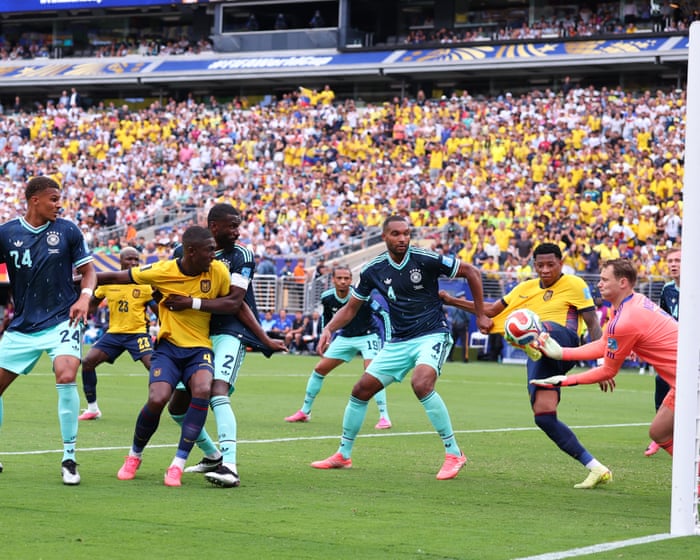
Germany's national football team finds itself in a challenging phase, torn between the echoes of its victorious past and the pressing need for future renewal. The lingering memories of the 2014 World Cup triumph and the looming influence of figures like Jürgen Klopp have sparked a complex debate about the team's current identity and direction.
Julian Nagelsmann's Frustration
Following a narrow 2-1 defeat to Ecuador in their last group stage match, Germany's head coach Julian Nagelsmann was visibly agitated during a post-match interview. The suggestion that Ecuador had simply desired the win more due to Germany's assured qualification irked Nagelsmann. "No, please, stop with this nonsense," he retorted, firmly rejecting the notion. "They didn’t want it more," he insisted, defending his players' commitment on the field.
Nagelsmann's sentiments, however, seemed somewhat at odds with the players' own reflections. Joshua Kimmich, a prominent figure in the squad, openly admitted, "The difference today was that the opponent wanted to win more than us." Similarly, Deniz Undav, who came off the bench during the match, echoed this sentiment, saying, "I had the feeling they wanted it more than us." This discrepancy highlights a potential disconnect within the team regarding their current performance and motivation.
The Haunting Legacy of 2014
The triumph at the 2014 World Cup in Brazil remains a pivotal moment in German football history. However, the success has become both a source of pride and a burden. The team's performance in subsequent tournaments has often been measured against this high benchmark, creating immense pressure on both players and coaching staff. As Germany strives to rebuild and redefine its identity, the specter of past glory continues to loom large.
- 2014 World Cup Victory: A historic win that still influences expectations.
- Current Performance: Recent matches reveal inconsistencies and challenges.
- Team Dynamics: A need for alignment between players and coaching strategies.
Looking Towards the Future
The discourse around Jürgen Klopp, an influential figure in world football, adds another layer to the conversation. While Klopp has not been directly involved with the national team, his name often surfaces in discussions about potential leadership changes and strategic directions. His approach and success at club level invite speculation about what he could bring to the national setup.
Meanwhile, Nagelsmann faces the daunting task of steering the team through this transitional phase. Balancing the ambition to build a new legacy while managing the expectations rooted in past achievements requires a nuanced approach. The upcoming tournaments will be critical in shaping the future narrative of German football.
"I cannot tell any of my players that they didn’t give it their all. That’s far too simplistic," Nagelsmann stated, emphasizing the complexity of the challenges faced by his team.
As Germany grapples with its identity crisis, the need for clarity and unity becomes ever more pressing. The ability to acknowledge and learn from past successes while forging a path forward will define the next chapter for this storied football nation.