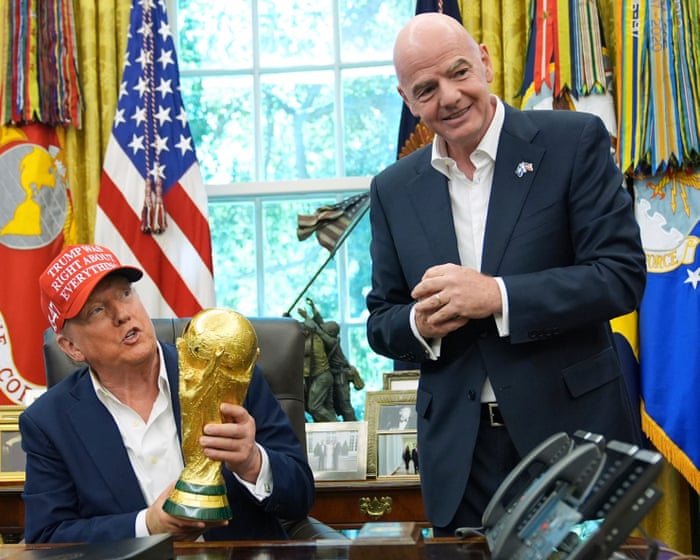
The recent intervention by former US President Donald Trump in an attempt to reverse Fifa's suspension of Folarin Balogun has stirred significant controversy. This move, seen by many as a quintessentially American display of power and influence, mirrors historical incidents where political figures have tried to sway the outcomes of crucial sporting events.
Balogun's Suspension Conundrum
Folarin Balogun, a promising talent for the US Men's National Team, found himself at the center of a disciplinary storm following a red card incident. According to Fifa's current regulations, a red card results in an automatic one-match suspension, a rule that applies uniformly across all levels of international football.
However, Trump's intervention, reportedly aimed at having this suspension overturned, has raised questions about the appropriateness and effectiveness of such political actions in the realm of sports. This incident has become a topic of heated debate, with opinions divided on whether political leaders should exert influence over international sporting bodies.
Historical Parallels: The Garrincha Incident
The controversy surrounding Trump's actions draws parallels to the 1962 World Cup incident involving Brazilian football legend Garrincha. During that tournament, Garrincha received a red card in the semifinals, but unlike today's automatic suspension rules, Fifa's disciplinary procedures then were less clear-cut.
In a tale that has become part of football folklore, the assistant referee with the best view of Garrincha's foul vanished amidst allegations of bribery. Concurrently, Chile's president, representing the host nation, is said to have pressured Fifa to allow Garrincha to play in the final. The outcome was favorable for Brazil, who went on to secure their second World Cup title with Garrincha on the field.
Implications for US Soccer
The attempt by Trump to influence Fifa's decision highlights a broader issue regarding the role of politics in sports. While his actions may have been intended to support the US team's performance, they risk undermining the integrity of international sports governance.
Critics argue that such interventions could set a dangerous precedent where political leaders across the globe might feel emboldened to sway sporting outcomes. This could lead to a loss of trust in the impartiality of sports organizations and the fairness of competition results.
The Potential Fallout
- Reputation Risks: The US Soccer Federation could face reputational damage on the global stage, as Fifa and its member associations may view this as an overreach of power.
- Impact on Balogun: The young player's focus could be disrupted by the off-field controversy, affecting his performance and development.
- Long-term Consequences: This incident might prompt Fifa to reassess its protocols and tighten its governance to prevent undue political interference.
As the situation unfolds, the football community will be keenly observing how Fifa responds to this unprecedented challenge. The organization has a responsibility to uphold its regulations and maintain the integrity of the sport, ensuring that decisions are made based on fairness rather than external pressures.
In the end, while Trump's involvement may have been intended to benefit the US team, it serves as a poignant reminder of the delicate balance between politics and sports, and the importance of preserving the sanctity of both domains.